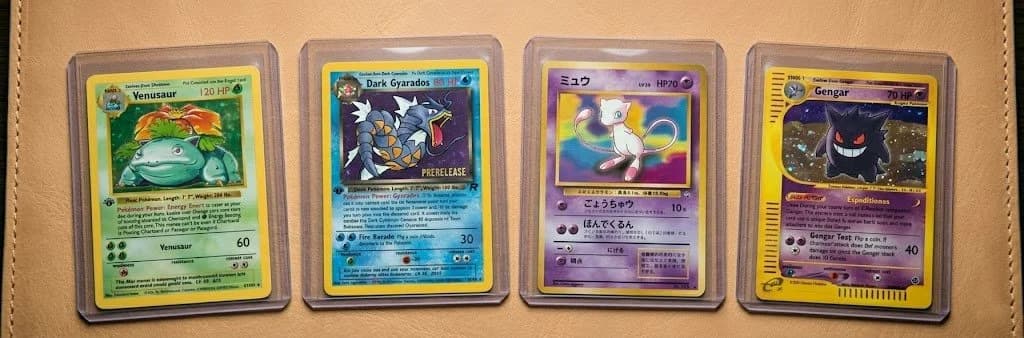
Condition is one of the most important factors in what a Pokémon card is worth, and one of the most consistently misunderstood. Most collectors overestimate the condition of their own cards. A card that looks fine in a binder sleeve under normal lighting can reveal scratches, edge wear, and print defects the moment a buyer examines it carefully.
Understanding how to assess your cards honestly — using the same criteria buyers and professional graders apply — means more accurate valuations, fewer disputes when you sell, and better decisions about which cards are worth submitting for professional grading.
Why Condition Matters More Than Most Collectors Realise
On a common card worth a pound or two, condition barely matters. On a card worth £50, the difference between Near Mint and Lightly Played can be £15 to £20. On a card worth several hundred pounds, that gap widens considerably — and the difference between a Near Mint raw card and a professionally graded PSA 10 of the same card can be several times the ungraded value.
Condition also affects how quickly cards sell. Buyers shopping at the higher end of the market are careful and experienced. A card listed as Near Mint that arrives in Lightly Played condition generates disputes, returns, and negative feedback. Listing accurately builds a reputation as a reliable seller, which matters if you sell regularly.
The Standard Condition Categories
The trading card hobby uses broadly consistent condition language across most platforms, though the precise definitions vary slightly between graders and marketplaces. These are the categories you will encounter most frequently as a UK collector.
Near Mint (NM)
The benchmark condition for most secondary market transactions. A Near Mint card has no visible wear on the edges or corners, no surface scratches visible at normal viewing distance, no creases, no print defects, and no significant whitening on the card back. The card looks essentially as it came out of the pack, handled carefully and stored immediately. Minor handling marks invisible at arm's length, very slight silvering on the edges of dark-backed cards, and negligible print texture are generally accepted. What it cannot have is anything a buyer would notice and comment on.
Lightly Played (LP)
A card that has seen some handling but remains in good overall condition. Light edge wear, minor corner softening, very light surface scratches, and slight whitening on the back edges are typical. The card is clearly not fresh from the pack but presents well and is appropriate for play or collection. Lightly Played cards sell at a modest discount to Near Mint — typically 10 to 25 percent depending on the card's value and the buyer's expectations.
Moderately Played (MP)
More visible wear — noticeable edge and corner whitening, surface scratches visible without close examination, possible light creasing, or scuffs on the card face. The card is structurally intact but shows clear signs of use. Appropriate for players who need a functional copy rather than collectors prioritising condition.
Heavily Played (HP)
Significant visible damage — heavy edge wear, corner damage, pronounced surface scratching, creasing, or any combination of these. Heavily Played cards retain value only where the card itself is desirable enough that collectors will accept a damaged copy, typically vintage cards where Near Mint copies are scarce.
Damaged
Cards with structural issues — tears, bends that have cracked the card face, water damage, or anything that permanently alters the card's physical integrity. Damaged cards have minimal secondary market value in most cases.
How to Assess Your Cards
Assessing condition accurately requires the right conditions and a systematic approach.
- 01
Use good lighting
Most condition problems are invisible under dim or diffuse light. Use a bright, direct light source — a lamp or a well-lit window — and tilt the card at different angles to catch surface scratches and haze that flat lighting conceals. This single step reveals more about a card's condition than any other.
- 02
Examine the edges first
Edge whitening on dark-backed Pokémon cards is the most common and most visible form of wear. Run your eyes along all four edges and look for whitening, chipping, or roughness. Near Mint cards have clean, sharp edges. Any visible whitening moves the card toward Lightly Played or below.
- 03
Check the corners
Corners soften with handling even when the rest of the card looks clean. Under good lighting, look for any rounding, whitening, or peeling at all four corners. A single damaged corner is enough to reduce a card from Near Mint to Lightly Played.
- 04
Examine the surface
Hold the card face-up and tilt it under your light source, moving it slowly. Surface scratches that are invisible face-on often catch the light clearly at an angle. Pay particular attention to dark or solid colour areas — holographic backgrounds, black borders, dark sky areas — where scratches show most visibly.
- 05
Check the card back
The back of a Pokémon card is often more revealing than the front. The dark blue Pokéball design shows whitening, scratching, and handling marks clearly. Many cards that appear Near Mint from the front show Lightly Played or worse on the reverse.
- 06
Assess centring
Hold the card at arm's length and look at the border width on all four sides. Perfect centring is rare — print runs produce natural variation — but significant off-centring reduces a card's grade, particularly in professional grading where centring is assessed as a specific criterion.
Common Mistakes When Self-Grading
Grading in sleeve
A card looks better in a penny sleeve or top loader than it does out of one. Sleeves hide edge wear and corner softening. Always remove the card from its sleeve before assessing condition.
Using poor lighting
Most collectors who list cards as Near Mint when they are Lightly Played are simply assessing them under inadequate light. Bright directional light is not optional for accurate condition assessment.
Grading emotionally
A card you paid £60 for feels like it should be Near Mint. A card you pulled yourself from a pack feels pristine. Neither of these feelings is relevant to what a buyer will see when they open the package. Assess the card as a stranger would.
Ignoring the back
The front of the card is what most collectors look at. The back is what graders and experienced buyers look at first, because it shows handling history more clearly.
When Professional Grading Is Worth Considering
Home condition assessment tells you where a card sits on the standard condition scale. Professional grading by services such as PSA or CGC goes further — a trained assessor examines the card under magnification, assigns a numeric grade on a ten-point scale, and seals the card in a tamper-evident case with the grade permanently recorded.
A PSA 10 Gem Mint is the benchmark that commands the strongest premium over raw card prices. PSA 9 Mint still carries a meaningful premium on desirable cards. Below PSA 8, the graded premium shrinks, and on lower-value cards the submission cost can exceed any uplift in value.
Professional grading makes financial sense under specific conditions. The card needs to be genuinely desirable — a sought-after chase card, a vintage rare, or a card with strong collector demand. It needs to realistically be capable of achieving a high grade, which means Near Mint at absolute minimum and preferably pristine. And the expected graded value needs to comfortably exceed the raw card price plus submission fees, postage, and the cost of the wait.
Turnaround times vary significantly by service tier and current demand. Economy submissions to PSA have historically taken anywhere from a few weeks to several months. If you need to sell quickly, grading is not the right route.
For the majority of cards in a typical collection, professional grading is not worth the cost. The cards worth submitting are the ones where the numbers clearly work — high raw value, strong condition, realistic path to PSA 9 or above, and a graded premium that justifies the process.
Knowing which cards in your collection meet that threshold starts with an accurate valuation. Once you know what each card is currently worth raw, the calculation for whether professional grading adds value becomes straightforward.
Know your cards' values before you decide what to grade
Scan any card and get a live GBP market price in seconds. Free to start.
Start scanning free